
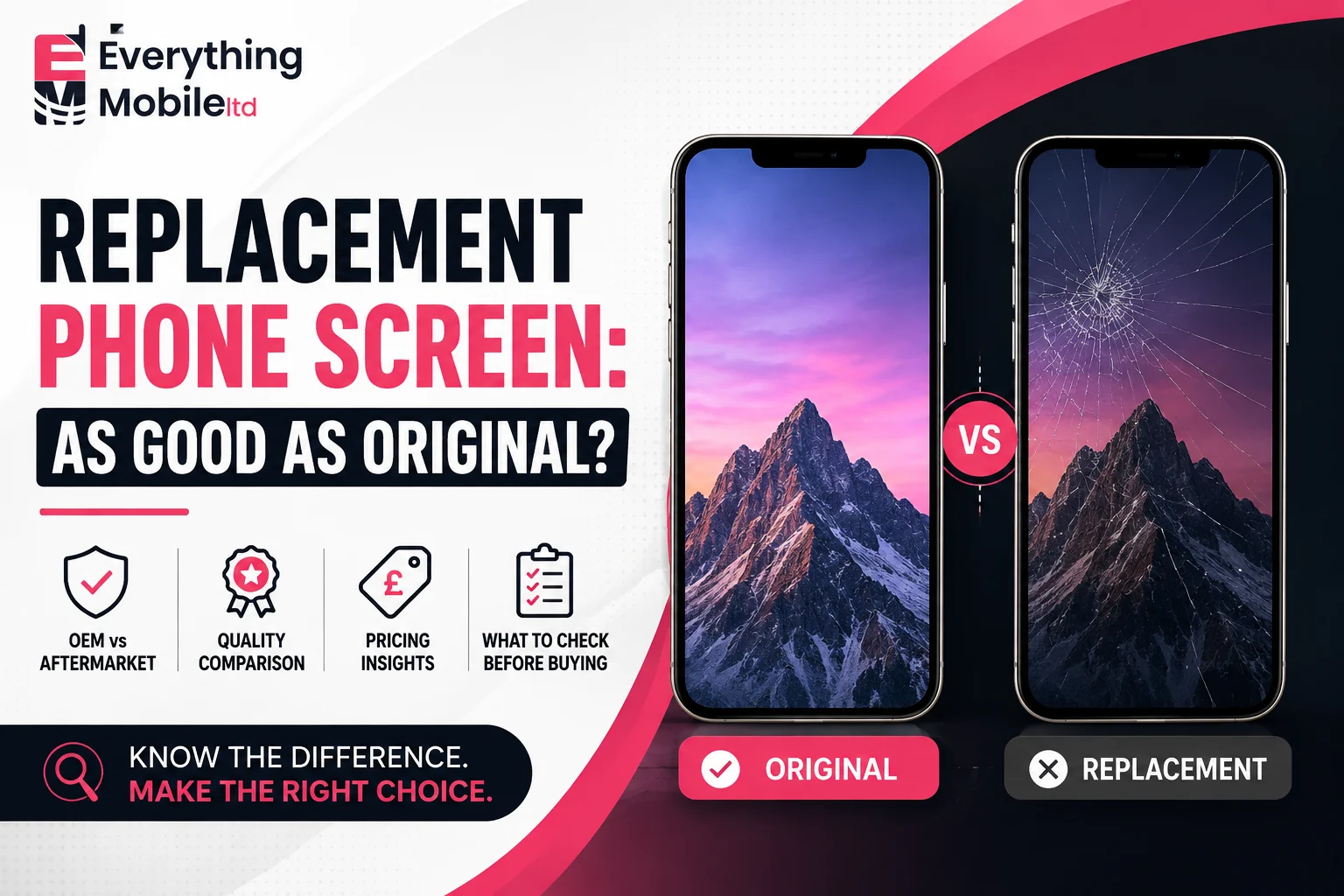
A cracked or unresponsive display is one of the most common reasons people and businesses look at swapping out a handset’s screen. But the moment you start comparing options, a fair question comes up: is a replacement phone screen actually as good as the Did you know Right to Repair legislation is now active in nearly half of US states? Right to Repair legislation is currently active in 24 states, with roughly 50 bills filed in 2025 alone. (pirg.org)one that came with the device?
The honest answer is that it depends entirely on the part itself, not just the price tag. Some replacement screens match original performance closely. Others fall short in ways that only show up after weeks of use. For anyone buying in volume, or advising customers on what to expect, knowing the difference matters more than most people realise.
Key Takeaways
- Screen quality varies widely between OEM, genuine, and aftermarket parts, even when prices look similar.
- Display technology, glass grade, and manufacturing consistency all affect real-world performance.
- Cheaper screens often cut corners on touch sensitivity, colour accuracy, or long-term durability.
- A short buying checklist can prevent most common sourcing mistakes.
- Businesses benefit from procurement guidance rather than choosing suppliers on price alone.
Why Screen Quality Matters More Than Price
It’s tempting to sort suppliers by price and pick from the top of the list. But a screen sits at the centre of how a phone feels to use every single day.
Poor touch response, dull colours, or a display that fails within months creates returns, refunds, and reputational damage for anyone reselling or repairing devices. That cost usually outweighs any saving made upfront.
Replacement phone screen cost varies for a reason. Materials, factory standards, and quality testing all add expense, and stripping those out is usually how a supplier reaches a lower price point.
For a business buying at scale, a screen that fails at month four is far more expensive than one that costs slightly more but lasts.
Replacement Phone Screen vs Original Screen
Not all replacement parts are built the same way, and the terminology can be confusing. Here’s what buyers are usually choosing between:
OEM (Original Equipment Manufacturer): An OEM replacement phone screen is made by, or for, the same manufacturer that supplied the original component. These typically match factory specifications closely.
Genuine parts: Sourced directly from the device manufacturer or an authorised channel, often removed from donor units or supplied through official repair programmes.
Aftermarket screens: Produced by third-party manufacturers to a similar specification, without direct manufacturer involvement. Quality here ranges from very close to original, to noticeably weaker.
Refurbished screens: Original screens that have been repaired, tested, and restored to working condition, often at a lower cost than new OEM stock.
Framing it as original phone screen vs replacement screen isn’t quite accurate, since a well-sourced replacement can perform close to the original. The real comparison is between grades of replacement part.
| Screen Type | Display Accuracy | Touch Response | Typical Lifespan | Relative Cost |
| OEM | Very close to original | Excellent | Long | Higher |
| Genuine | Matches original | Excellent | Long | Higher |
| Aftermarket (high grade) | Good | Good to very good | Moderate to long | Mid-range |
| Aftermarket (low grade) | Inconsistent | Variable, prone to lag | Short to moderate | Lower |
| Refurbished | Matches original | Excellent | Depends on condition | Mid-range |
What Determines the Quality of a Replacement Screen?
Several factors decide whether a screen performs well once fitted, and most of them aren’t visible from a product photo.
Display technology. OLED panels generally offer deeper blacks and better contrast, while LCD alternatives can be a reasonable, lower-cost option depending on the original device.
Brightness and colour accuracy. Lower-grade panels often struggle in daylight or display slightly inaccurate colour tones, particularly noticeable on white backgrounds.
Touch responsiveness. The digitiser layer needs precise calibration. Weak calibration shows up as missed taps, delayed scrolling, or inconsistent gestures.
Glass quality. Thinner or lower-spec glass scratches and cracks more easily, even with normal handling.
Manufacturing standards. Consistency between production batches affects whether every unit performs the same way, which matters a great deal for anyone buying in volume.
This combination is really what replacement phone screen quality comes down to. Two screens can look identical in a listing and perform very differently once installed.
Common Problems with Low-Quality Replacement Screens
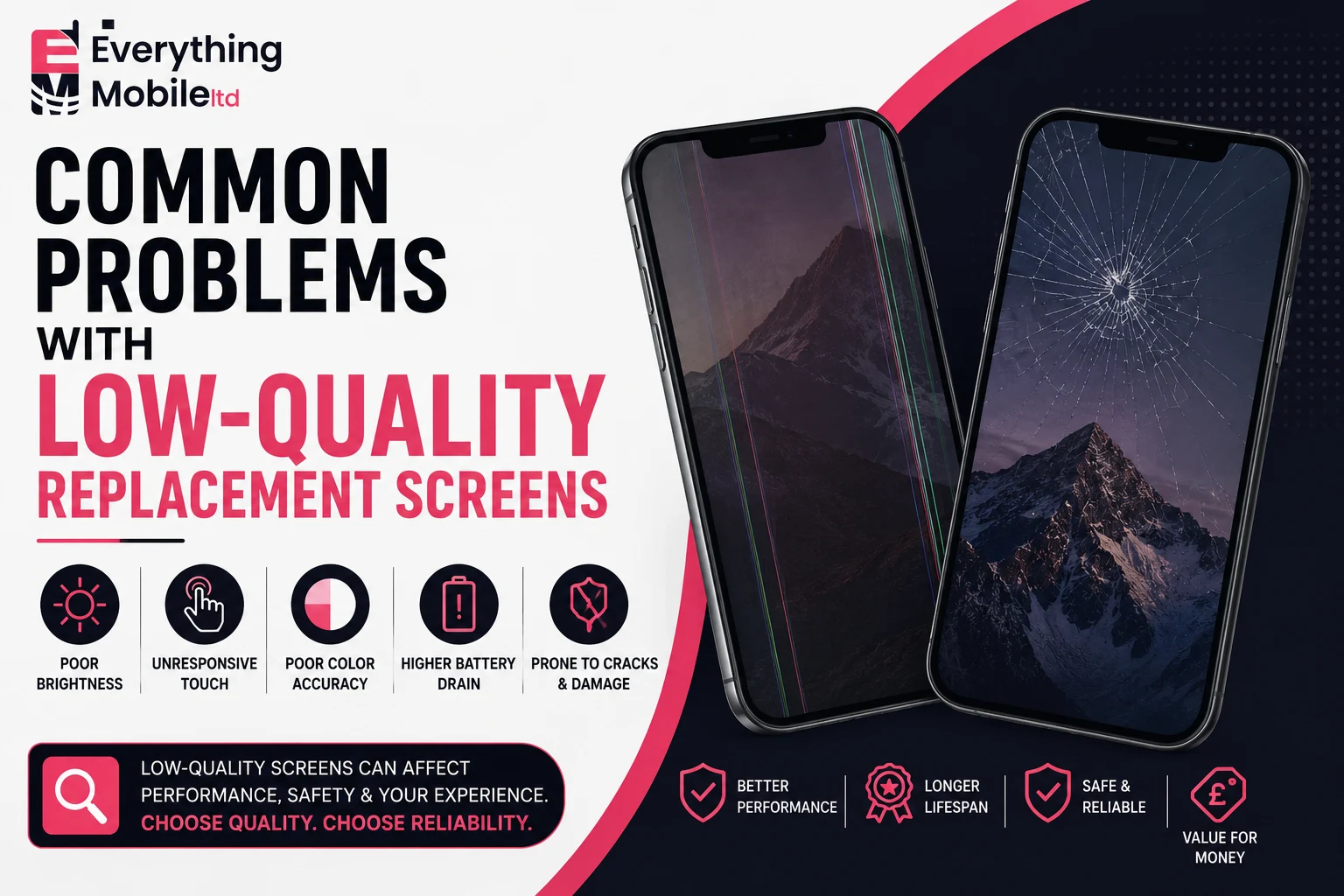
Buyers who source purely on price tend to run into a familiar set of issues:
- Ghost touch, where the screen registers taps that never happened
- Poor brightness, especially in outdoor or well-lit conditions
- Dead or stuck pixels visible on plain backgrounds
- Colour shift, where whites appear yellow, blue, or grey
- Weak glass that chips or cracks under light pressure
- Faster battery drain caused by poorly matched display components
- Screen lifting at the edges after a short period of use
- Touch lag during scrolling, typing, or gaming
Any one of these can be an isolated fault. Seeing several across a batch usually points to a wider sourcing or manufacturing problem.
Questions Buyers Should Ask Before Purchasing
A short checklist can prevent most costly mistakes before an order is placed.
Buying Checklist:
- What grade is this part: OEM, genuine, aftermarket, or refurbished?
- Has phone screen compatibility been confirmed for the exact model and variant?
- What warranty or return policy applies if a fault appears?
- Has the supplier provided sample units for testing before a bulk order?
- What quality control checks happen before parts are shipped?
- Are batch numbers or traceability details available if a fault needs investigating?
- How does the price compare to typical market rates for that same grade?
- Is there a consistent supply, or does quality vary between shipments?
Asking these questions upfront takes a few extra minutes and avoids far more time lost to returns later.
How Businesses Can Source Better Replacement Screens
For repairers, resellers, and retailers, screen sourcing is rarely a one-off decision. It’s an ongoing procurement relationship, and the supplier chosen affects margins, return rates, and customer trust over time.
A dependable replacement phone screen supplier UK businesses can rely on should offer consistent grading, transparent sourcing, and support when something goes wrong. Chasing the lowest unit price across multiple, unverified suppliers often costs more once faults, delays, and inconsistent batches are factored in.
This is where a procurement-focused partner adds value. Everything Mobile Limited works with businesses on sourcing and supply decisions for mobile components, helping buyers weigh quality, cost, and reliability before committing to a supplier, rather than promoting any single fix.
Getting this right at the sourcing stage tends to prevent most of the quality problems covered earlier in this article.
The Bottom Line
A replacement phone screen can match original performance when it’s the right grade, from a supplier with proper quality control. It can also fall well short when corners are cut to hit a lower price.
For individual buyers, that mostly affects one device. For businesses buying at volume, it affects margins, customer satisfaction, and reputation across every unit sold or repaired.
Asking the right questions before ordering, and choosing a high-quality replacement phone screen over the cheapest option available, tends to pay off well beyond the initial purchase.
Ready to Source with Confidence?
Sourcing decisions get easier with the right guidance behind them. Everything Mobile Limited supports businesses with mobile component procurement, helping teams compare options and make informed choices rather than rushing into low-cost purchasing decisions that cost more down the line.
If screen sourcing is currently a guessing game for your business, getting expert procurement input before the next order is a reasonable next step.
FAQs
Q1: Are replacement phone screens as good as original ones?
Some are, some aren’t. OEM, genuine, and well-made aftermarket screens can perform very close to original. Lower-grade aftermarket parts often fall short on touch accuracy, brightness, or durability.
Q2: OEM vs aftermarket phone screen: what’s the real difference?
OEM parts are made to, or very close to, factory specification. Aftermarket parts are produced independently and vary widely in quality, from near-identical to noticeably weaker.
Q3: How long should a replacement screen last?
A good quality replacement should last as long as the device itself is in regular use, typically several years. Lower-grade parts may show issues within months.
Q4: Can a replacement screen affect touch sensitivity?
Yes. The digitiser layer beneath the glass needs accurate calibration. Poorly made screens often show delayed response, missed taps, or inconsistent gestures.
Q5: Why are some replacement screens cheaper?
Lower prices usually reflect reduced material quality, less rigorous testing, or lower manufacturing consistency. Cost savings have to come from somewhere in the production process.