
A cracked screen is one of those problems that seems to demand an immediate and expensive solution. Many people instinctively start browsing for the latest handset online, assuming that a smashed display means the end of the road for their current phone. But the truth is far more practical. A phone screen replacement is almost always the smarter, faster, and far more affordable path forward, and the evidence for that is stronger than most people realise.
In 2026, repair-first thinking is no longer just a budget-friendly option. It aligns with growing consumer awareness around sustainability, device longevity, and smart financial choices. Whether you have a standard Android handset or need an iPhone 7 phone screen replacement specifically, fixing what you have rather than replacing it outright saves money, cuts down e-waste, and keeps your device working exactly the way you are used to it.
This guide walks through every key reason why screen repair wins over a brand-new purchase, what you need to know before booking a repair, and how to make the most of your existing phone for years to come.
| Did You Know?
According to the UK Government’s official resource efficiency statistics, the UK generates over 1.45 million tonnes of waste electrical and electronic equipment (WEEE) each year. Choosing phone screen replacement over buying a new device directly reduces the volume of electronic waste entering the waste stream. You can read more at the official UK government WEEE guidance: gov.uk/guidance/waste-electrical-and-electronic-equipment-weee-explained |
Key Takeaways
- Cost savings: Screen replacement typically costs 70 to 85 percent less than buying a new equivalent device.
- Same familiar phone: Your apps, contacts, photos, and settings stay exactly where they are.
- Faster turnaround: Most professional screen replacements are completed same-day or within hours.
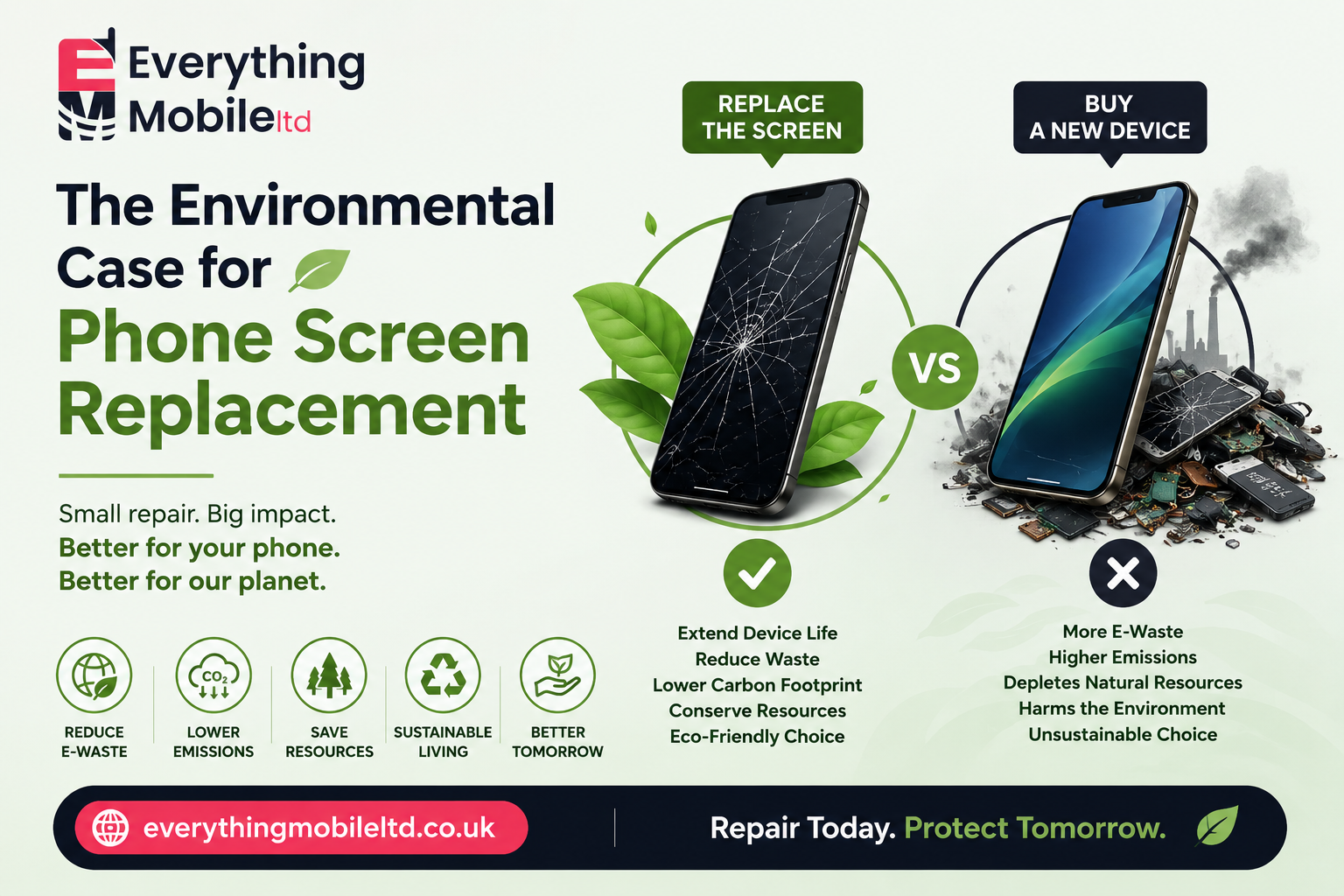
- Environmental benefit: Repairing reduces e-waste and the carbon footprint of manufacturing a new phone.
- Supports Right to Repair: EU and UK Right to Repair legislation now backs consumers who choose repair over replacement.
- Works on all major brands: Including iPhone 7, Samsung, Google Pixel, and most other models.
The Real Cost of Buying a New Phone vs. Replacing a Screen
When you pick up a brand-new handset, the sticker price is just the beginning. Most flagship phones in 2026 cost anywhere from £700 to over £1,200. Mid-range options sit between £250 and £500. Meanwhile, a professional screen replacement for most popular models ranges from £50 to £180, depending on the device and whether it is an OEM or aftermarket panel.
The maths is straightforward. Even on a mid-range phone, choosing to replace phone screen rather than buying a new handset saves the average user several hundred pounds. That saving is even more significant when you factor in accessories, SIM transfers, insurance policies that need updating, and the sheer time spent setting up a new device from scratch.
Beyond the upfront spend, consider the hidden costs: new contract agreements if you are upgrading through a carrier, the depreciation hit on your current device if you try to trade it in with a cracked screen, and the hours lost migrating data and reinstalling apps.
Cost Comparison: Screen Replacement vs New Phone
| Item | Screen Replacement | Buying New Device |
|---|---|---|
| Average Cost | £50 to £180 | £250 to £1,200+ |
| Data Migration Needed | No | Yes |
| Setup Time | Same day | Several hours |
| Accessories Needed | None | Often yes |
| E-Waste Impact | Minimal | High |
Your Data, Your Apps, Your Settings Stay Intact
One of the biggest and most underappreciated advantages of a replacement phone screen is that you walk away from the repair shop with the same phone you walked in with. Your photos are still there. Your WhatsApp history is intact. Your banking apps, two-factor authentication setups, and favourite playlists are all exactly where you left them. Nothing needs to be migrated, reinstalled, or reconfigured.
When you buy a new phone, even with a cloud backup, restoring everything to its exact prior state is rarely seamless. Certain apps do not restore cleanly. Some authentication tokens expire during a device switch. Login credentials stored locally on your old phone may not transfer. For people who rely on their phones for work, this kind of disruption can mean hours of lost productivity.
There is also the matter of familiarity. After months or years of use, you know exactly where everything is on your current phone. Switching to a new handset, even the same model, means re-learning gestures, re-arranging your home screen, and adapting to a new operating system version. Screen replacement removes all of that friction. Check out our in-depth guide on how to fix a cracked phone screen quickly to understand what the repair process actually involves.
The Environmental Case for Phone Screen Replacement
Manufacturing a smartphone requires a staggering amount of resources. Rare earth metals, cobalt, lithium, and complex chemical processes all go into producing a single handset. The carbon footprint of manufacturing a new smartphone is estimated to account for 70 to 80 percent of its total lifetime emissions. Every time you choose repair over replacement, you are directly cutting that manufacturing demand.
The UK Government has progressively tightened WEEE regulations, and Right to Repair legislation introduced across the EU and supported by UK policy now requires manufacturers to make spare parts more accessible. This is not just a legal development. It signals a fundamental shift in how society views device longevity. Repairing is no longer a workaround. It is the preferred, government-endorsed approach.
If you are already thinking about the environmental footprint of your devices, you may also want to read about how to recycle your old and broken mobile phones safely, which covers responsible disposal options when a device genuinely does reach end of life.
iPhone 7 Phone Screen Replacement: A Practical Example
The iPhone 7 remains one of the most widely used smartphones in the UK. It handles everyday tasks without complaint, runs current app versions, and holds its performance well. An iPhone 7 phone screen replacement is a well-documented, straightforward repair that most reputable shops can complete in under two hours.
A quality replacement screen for the iPhone 7 costs between £60 and £120 depending on whether an OEM panel or a high-grade aftermarket equivalent is used. Compare that to the cost of replacing the entire device. Even a second-hand iPhone 7 in good condition costs significantly more than a screen repair, and buying a newer model to replace a perfectly functional phone simply because the glass cracked is a significant unnecessary expense.
The same logic applies across almost every popular handset. Samsung Galaxy screens, Google Pixel displays, OnePlus panels, all of these are repairable at a fraction of the replacement device cost. The phone itself, its processor, battery, cameras, and connectivity hardware, is almost certainly still fully functional after a screen crack. You are not replacing the phone. You are replacing a pane of glass.
How to Spot a Quality Phone Screen Replacement Service
Not all repair shops are equal, and knowing what to look for before you hand over your phone matters. The quality of the replacement screen, the experience of the technician, and the warranty offered all directly affect how satisfied you will be with the outcome.
What to Look for in a Repair Provider
- Check whether the shop offers OEM or high-quality OEM-equivalent screens, not cheap aftermarket panels that degrade quickly.
- Ask about the warranty. A reputable repairer will back their work with at least a 90-day guarantee on parts and labour.
- Look for transparency on pricing. The quote you receive before the repair should match the invoice.
- Read customer reviews on Google and Trustpilot. Consistent positive feedback on screen quality and turnaround time is a reliable indicator.
- Check if the shop has experience with your specific model. Some older or less common devices require specialist knowledge.
If your phone has additional damage beyond the screen, such as a malfunctioning touch sensor or a damaged frame, it is worth reading about the top signs you need immediate broken phone repair so you understand the full scope of what might need attention.
What Happens During a Professional Screen Replacement
Understanding the repair process helps set expectations and reassures first-time customers. A professional phone screen replacement is methodical, not improvised, and skilled technicians follow a consistent process for each model.
- Initial diagnosis: The technician checks the existing screen for touch responsiveness and inspects surrounding components for any additional damage.
- Safe disassembly: The phone is powered off and opened using precision tools. Heat is applied to soften adhesive on newer models.
- Screen removal: The cracked panel is carefully detached, and any adhesive residue is cleaned from the frame.
- Component transfer: On some models such as the iPhone, the earpiece speaker, front camera, and Face ID components are transferred from the old screen to the new one.
- New screen installation: The replacement screen is connected and tested for full touch and display functionality before being sealed in place.
- Final quality check: Brightness, touch responsiveness, colour accuracy, and any front-facing camera or sensor functions are all verified before the phone is returned.
The entire process for most popular models takes between 30 minutes and 2 hours. In many cases, you can drop your phone off in the morning and collect it the same afternoon.
When Is Buying a New Phone Actually the Right Choice?
This guide advocates strongly for repair, but it is also important to be honest about the situations where buying a new device makes more sense. Repair is not always the answer.
- The device is several generations old: If the phone no longer receives software security updates and the manufacturer has ended support, the security risk of continuing to use it may outweigh the repair cost.
- Multiple components have failed: If alongside the screen, the battery is swollen, the charging port is broken, and the camera is damaged, the cumulative repair cost may approach or exceed the value of a replacement.
- The screen is not the only structural damage: A device that has suffered frame damage, water ingress, or motherboard failure alongside a broken screen may not be viable for repair.
In those scenarios, the next most responsible option is not necessarily buying new. Refurbished phones offer an excellent middle ground, giving you a fully tested, quality-checked device at significantly below the new-device price. If you are considering that route, our guide on
everything you need to know about refurbished mobile phones is a useful starting point.
| Ready to Fix Your Phone Screen Today?
Stop putting up with a cracked screen and avoid the unnecessary cost of replacing your whole device. Everything Mobile Limited offers fast, professional phone screen replacements backed by quality parts and a satisfaction guarantee. Get in touch today and have your screen replaced, often on the same day. |
Frequently Asked Questions
Q1: How much does a phone screen replacement typically cost in the UK?
The cost varies by model and repair provider, but most popular handsets fall in the £50 to £180 range for a professional screen replacement. Older models like the iPhone 7 are generally at the lower end of that scale, while newer flagship devices may be higher.
Q2: Is it safe to use a phone with a cracked screen?
Using a phone with a cracked screen carries risks. Glass shards can cause minor cuts, moisture can enter through cracks and cause internal damage, and touch sensitivity is often affected. It is advisable to get the screen replaced promptly rather than continuing to use a damaged display.
Q3: Will a screen replacement void my phone warranty?
If your device is still under manufacturer warranty, using an unauthorised repair service may affect that warranty for screen-related claims. However, under Right to Repair legislation introduced in the UK and EU, manufacturers are increasingly required to support repair. It is worth checking your specific warranty terms before proceeding.
Q4: Can all phone screens be replaced, or only certain models?
The vast majority of popular smartphones, including all major iPhone models, Samsung Galaxy devices, Google Pixel phones, and most Android handsets, can have their screens professionally replaced. Some very old or rare models may have limited parts availability.
Q5: How long does a phone screen replacement take?
For most standard models, a professional screen replacement takes between 30 minutes and 2 hours. Complex models with embedded components like Face ID sensors may take slightly longer, but same-day service is the norm for most common devices.